How Long Until 1:50? Quick Ways to Count the Time Left
The time left until 1:50 equals 1:50 minus the current time. If it is 12:20, you wait 1 hour and 30 minutes. You can work it out in seconds once you know the trick.
This guide covers the simple math, a ready made chart, and a few mental shortcuts. It also clears up the AM and PM mix up that trips most people. Check your clock, pick your case, and you will have the answer before your coffee cools.
Quick Facts About Counting to 1:50
The remaining time is always the target time minus the current time. Here are the core numbers behind that rule.
| Detail | Value |
| 1:50 AM in minutes after midnight | 110 |
| 1:50 PM in minutes after midnight | 830 |
| 24 hour clock form | 01:50 and 13:50 |
| Minutes in one hour | 60 |
| Gap between the two daily 1:50 marks | 12 hours |
| Fastest manual method | Count to the next full hour, then add the rest |
How Long Until 1:50 Right Now?

The answer depends on the exact moment you ask. A clock showing 11:30 PM means 2 hours and 20 minutes to go for 1:50 AM.
Every day has two 1:50 moments, one in the early morning and one in the afternoon. Your next one is whichever comes first on the clock.
Here is the quick logic:
- Before 1:50 AM, the next target is 1:50 AM today.
- Between 1:50 AM and 1:50 PM, the next target is 1:50 PM today.
- After 1:50 PM, the next target is 1:50 AM tomorrow.
The Step by Step Method
The easiest method is to count up to the next full hour, then add the leftover minutes. It works for any starting time.
- Write down the current time.
- Count the minutes to the next hour mark.
- Count the full hours from there up to 1:00.
- Add 50 minutes for the final stretch.
- Add all three parts together.
Take 9:40 PM as a test. It is 20 minutes to 10:00 PM. From 10:00 PM to 1:00 AM is 3 hours. Add the last 50 minutes. The total is 3 hours and 70 minutes, which rolls over to 4 hours and 10 minutes.
Notice the roll over. Any minute total above 59 turns into an extra hour. Seventy minutes becomes 1 hour and 10 minutes.
Worked Examples You Can Copy
Practice makes this feel automatic. These examples use different starting points so you see each pattern.
Example 1: A late night wait
Say it is 10:45 PM. You want the clock to hit 1:50 AM.
Convert to the 24 hour clock. That makes 22:45. Minutes since midnight come to 1,365. Minutes left in the day are 1,440 minus 1,365, which is 75. Add 110 minutes for the new day. The total is 185 minutes, or 3 hours and 5 minutes.
Read More: How Long Until 10:15? Quick Ways to Find the Exact Wait
Example 2: Just after midnight
It is 12:15 AM. The target is only a short hop away.
From 12:15 to 1:15 is one hour. Then 35 more minutes reach 1:50. You wait 1 hour and 35 minutes.
Example 3: Morning to afternoon
It is 8:10 AM and you are counting to 1:50 PM. The gap spans most of the morning.
From 8:10 to 1:10 is 5 hours. Add 40 minutes to reach 1:50. The answer is 5 hours and 40 minutes.
Example 4: Almost there
The clock reads 1:44 PM. Subtract 44 from 50. You have 6 minutes left.
A Ready Made Time Chart
This chart gives the wait for common starting times. Use it as a fast lookup.
| Current time | Wait until 1:50 AM | Wait until 1:50 PM |
| 7:00 AM | 18 h 50 min | 6 h 50 min |
| 9:25 AM | 16 h 25 min | 4 h 25 min |
| 11:10 AM | 14 h 40 min | 2 h 40 min |
| 12:00 PM | 13 h 50 min | 1 h 50 min |
| 1:05 PM | 12 h 45 min | 45 min |
| 8:00 PM | 5 h 50 min | 17 h 50 min |
| 9:30 PM | 4 h 20 min | 16 h 20 min |
| 11:40 PM | 2 h 10 min | 14 h 10 min |
| 12:15 AM | 1 h 35 min | 13 h 35 min |
| 1:20 AM | 30 min | 12 h 30 min |
The two columns always differ by exactly 12 hours. That is a handy check on your own math.
AM or PM: Which 1:50 Do You Mean?
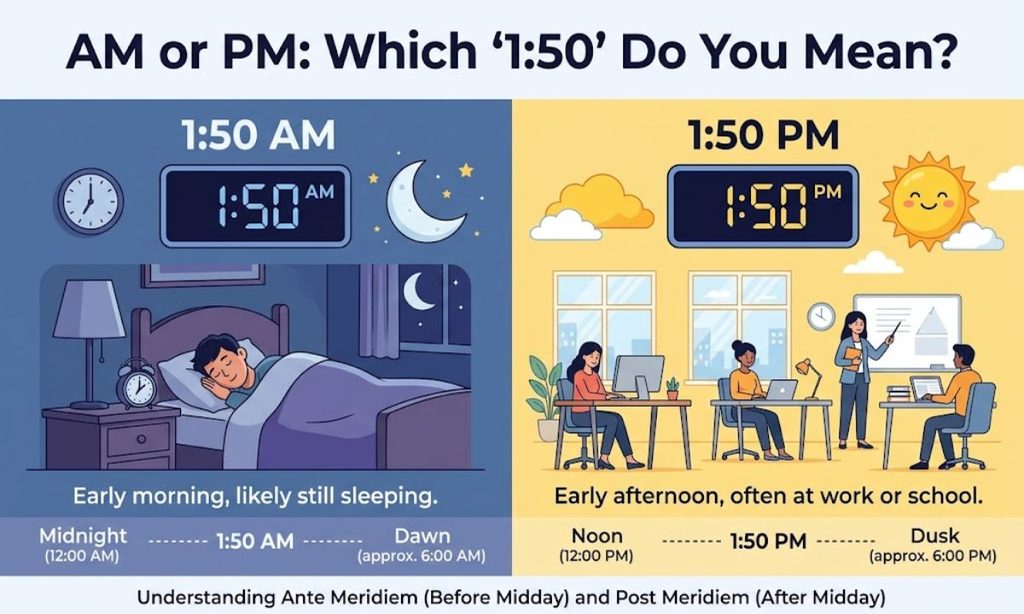
1:50 AM falls in the dead of night, and 1:50 PM falls right after lunch. Mixing them up creates a 12 hour error.
Look at your context. A flight alert, a shift change, or a bedtime plan usually points to one of them. When a message gives no label, ask for clarity before you plan around it.
The 24 hour clock removes the guesswork. It writes 1:50 AM as 01:50 and 1:50 PM as 13:50. Many airlines, hospitals, and transit systems use it for this reason.
Counting Across Midnight
When your wait crosses midnight, split the trip into two pieces. Time before midnight plus time after midnight gives the full total.
Here is a clean way to handle it:
- Find the hours and minutes until 12:00 AM.
- Add 1 hour and 50 minutes for the time after midnight.
- Combine and fix any minute total above 59.
At 11:25 PM, you have 35 minutes to midnight. Add 1 hour and 50 minutes. The sum is 1 hour and 85 minutes, which becomes 2 hours and 25 minutes.
People often forget the midnight split. They subtract 11:25 from 1:50 directly and get a negative number. Adding 12 or 24 hours fixes that, but the split method feels more natural.
Counting With Seconds
For a precise countdown, convert everything to seconds. One hour holds 3,600 seconds. One minute holds 60.
A wait of 2 hours and 10 minutes equals 7,800 seconds. That is 2 times 3,600 plus 10 times 60. Event timers, exam clocks, and launch countdowns often work this way.
Time Zones and 1:50
1:50 means something different in each city. A friend in another zone sees a different clock reading at the same moment.
Say a colleague lives five hours ahead of you. When your clock says 8:50 PM, theirs says 1:50 AM. For you, that moment is still hours away on your own 1:50 AM mark.
Check these before you plan a call or a stream:
- The other city’s offset from your own time
- Whether either place uses daylight saving time
- The date on both sides, since midnight can shift it
Daylight saving changes catch people off guard. One lost or gained hour moves the whole countdown. Confirm the offset for the exact day you plan to use.
Mental Shortcuts That Save Time
A few quick habits make this math painless. Try them until they feel natural.
Anchor to 2:00
1:50 sits ten minutes before 2:00. Count the time to 2:00, then subtract ten minutes. At 11:00 PM, the wait to 2:00 AM is 3 hours. Subtract 10 minutes to get 2 hours and 50 minutes.
Use round hours
Skip the awkward minutes at first. Count whole hours, then fix the minutes at the end. This keeps your head clear.
Check with the chart
Compare your answer to a nearby row in the table above. If your result lands close, you are probably right.
Say it out loud
Talking through the steps catches errors. It sounds silly, but it works.
Common Mistakes to Avoid
Most errors come from a few repeat habits. Watch for these.
- Ignoring AM and PM. A 12 hour slip is the most common error.
- Treating 60 as 100. Minutes roll over at 60, so 70 minutes means 1 hour and 10 minutes.
- Forgetting midnight. Direct subtraction fails when the wait crosses into a new day.
- Skipping the date. Counting to 1:50 AM tomorrow differs from counting to 1:50 AM today.
- Misreading the current time. A quick glance at a fast or slow clock ruins everything.
Tools That Do the Math for You
A phone timer or clock app gives the fastest and safest answer. Set an alarm for 1:50 and the device shows the time left.
A few options work well:
- The alarm function on any smartphone
- A built in countdown timer
- A voice assistant, which can say how long until a set time
- A spreadsheet that subtracts two time cells
Tools are great, yet knowing the manual method keeps you steady when a battery dies.
Frequently Asked Questions
How long until 1:50 if it is 12:50?
You wait exactly one hour. Add 60 minutes to 12:50 and you land on 1:50.
How many minutes until 1:50 from 1:00?
You wait 50 minutes. The hour mark leaves only the final 50 minutes.
Is 1:50 AM the same as 01:50?
Yes. The 24 hour clock writes 1:50 AM as 01:50.
What is 1:50 PM in 24 hour time?
It is 13:50. Add 12 to the hour for any PM time after noon.
How do I know which 1:50 is next?
Check your current time. Before 1:50 AM, the AM mark is next. After 1:50 PM, the next one is 1:50 AM tomorrow.
Final Thoughts
Working out how long until 1:50 comes down to one steady habit. Count to the next full hour, add the middle hours, then finish with the last 50 minutes. Fix any minute total above 59, and you have the answer.
Keep the chart, the midnight split, and the AM and PM check close by. With a little practice, you can answer how long until 1:50 faster than most people can open a timer app.

Olivia Bennett is a passionate naming writer who creates unique, meaningful, and creative name ideas for babies, pets, businesses, characters, and more. She enjoys researching name meanings, origins, and trends to help readers find the perfect name with confidence through simple, inspiring, and easy-to-follow guides.